

A mysteriously dimming star located about 1,480 light-years away in the constellation of Cygnus and known as Tabby's star is, in fact, a binary stellar system, made up of a F-type star and a smaller red dwarf star.

The signal appears to emanate from the direction of our neighboring star and cannot yet be dismissed as Earth-based interference, raising the very faint prospect that it is a transmission from extraterrestrial intelligence.

Until now, the source of Fast Radio Bursts was a mystery. Now astronomers at multiple institutions have pinpointed the FRB spotted in the Milky Way and conclude it most likely was generated by a magnetar.

Four of these strange objects have been detected and an international team of astronomers has nicknamed them ORCs - short for "Odd Radio Circles". All four are only visible in radio wavelengths.

Can a massive star collapse into a black hole without first exploding in a supernova blast? That’s at least one explanation for the disappearance of a star 2.5 mil times brighter than the sun in a dwarf galaxy 75 mil light years away.

Astronomers have discovered that emissions from an object known as a repeating Fast Radio Burst follow a cyclic pattern repeating every 157 days.

Astronomers have found two objects that, added to a strange object discovered in 2018, constitute a new class of cosmic explosions. They share some characteristics with supernova explosions and gamma-ray bursts.

A Milky Way magnetar called SGR 1935+2154 may have just massively contributed to solving the mystery of powerful deep-space radio signals that have vexed astronomers for years.

The object, called Fomalhaut b, was first announced in 2008. It was clearly visible in several years of Hubble observations that revealed it was a moving dot. Now it has vanished and scientists seek for a plausible explanation.

One of the core assumptions of astronomy is that the universe appears the same in all directions, or it is isotropic. However, a recent study suggests that may not be the case.
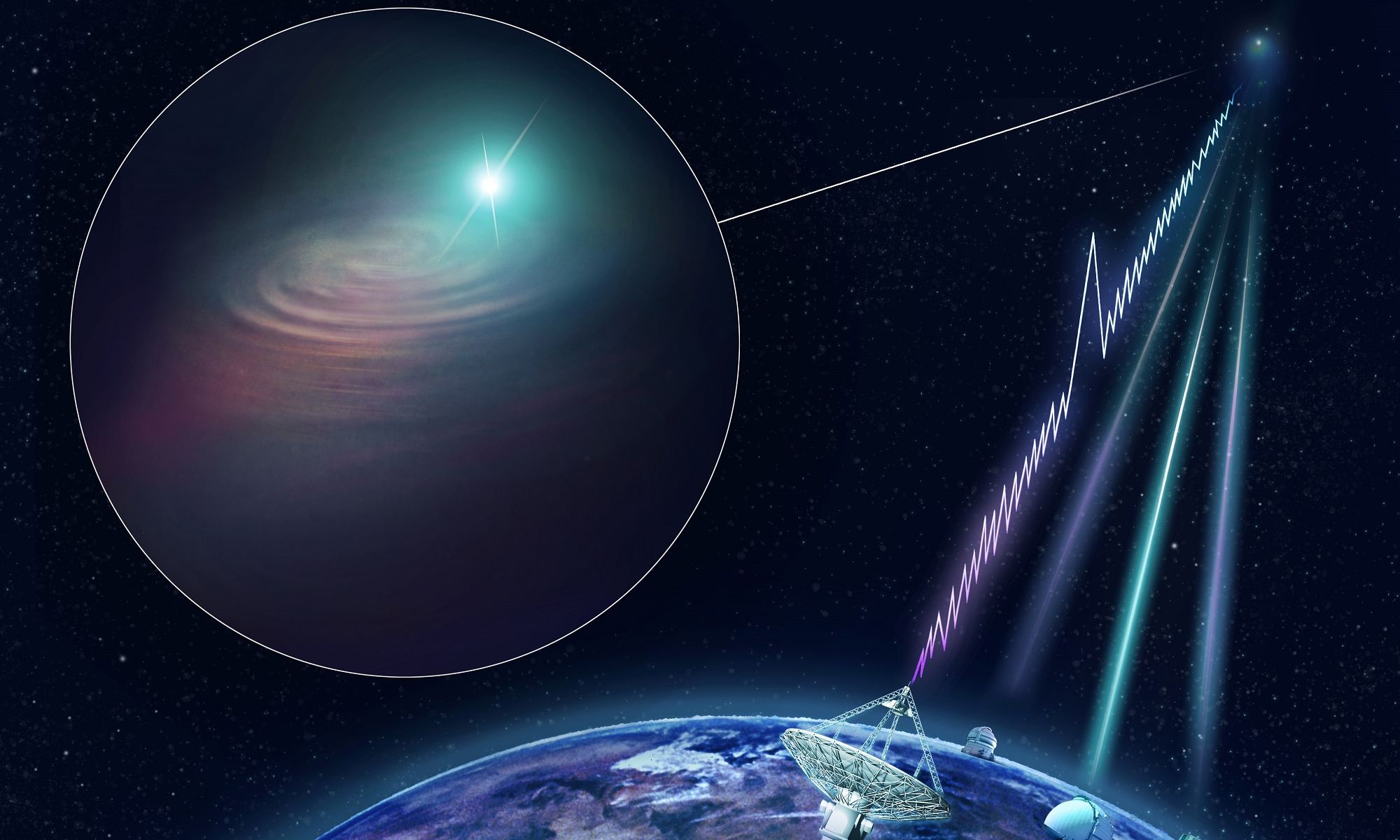
The CHIME radio telescope array has detected nine new fast radio bursts on repeat, which are revealing things about this strange phenomenon.

It's calculated that, thanks to rapid inflation, the universe may contain more than 1 googol (10^100) stars, and if this is the case then more complex, life-sustaining RNA structures are more than just probable, they're practically inevitable.

A comparative analysis of historical and contemporary astronomical data has resulted in the discovery of approximately 100 star-like objects that unexpectedly vanished. These strange occurrences are likely natural, but scientists say alien technology is a remote possibility.

Scientists have been gathering a growing well of evidence that our universe may be connected via a vast array of large-scale "structures" that seem to reach out across the cosmos to synchronize the movements of galaxies that are separated by vast distances.

Astronomers detected a giant planet orbiting a small star. The red dwarf GJ 3512 is located 30 light-years from us. The planet has much more mass than theoretical models predict.


